Key takeaways
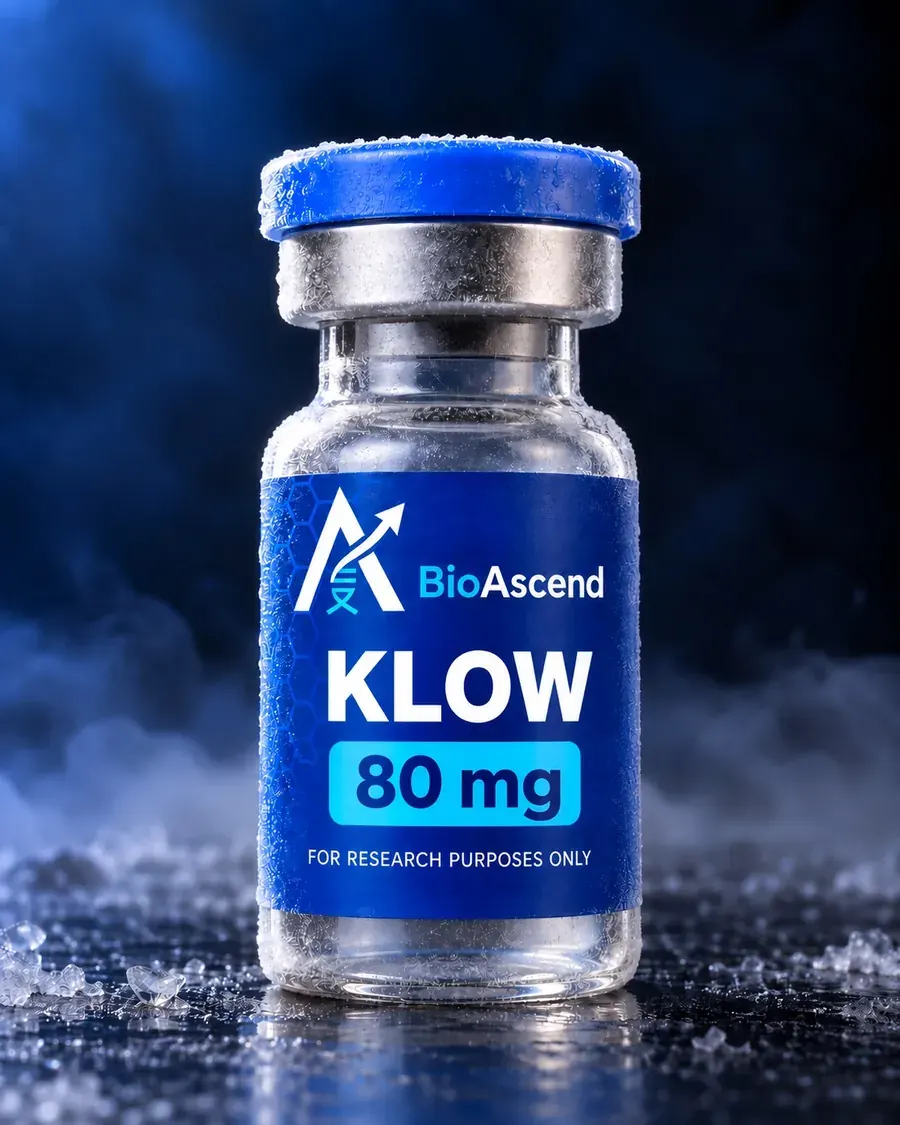
- KLOW is an 80mg blend: GHK-Cu 50mg, BPC-157 10mg, TB-500 10mg and KPV 10mg in one lyophilized vial.
- The four components are studied in different pathways: matrix remodelling, angiogenesis, actin-driven cell migration and NF-κB inflammatory signalling.
- Each component has its own research literature, but there's very little published research on the four-way combination itself.
In this guide
View KLOW 80mg →What's in KLOW
| Component | Amount | What it is | Main research focus |
|---|---|---|---|
| GHK-Cu | 50mg | Copper-binding tripeptide (Gly-His-Lys) | Collagen and extracellular matrix synthesis, gene expression |
| BPC-157 | 10mg | 15-amino-acid fragment of a gastric protein | Tendon, ligament and GI injury models; angiogenesis |
| TB-500 | 10mg | Synthetic thymosin beta-4 (or its active fragment) | Actin regulation, cell migration, wound repair |
| KPV | 10mg | Lys-Pro-Val tripeptide from α-MSH | NF-κB and inflammatory cytokine signalling |
KLOW builds on the well-known BPC-157 + TB-500 pairing by adding two more compounds: GHK-Cu, which makes up most of the blend by weight, and KPV.
How each component is studied
GHK-Cu
GHK is a tripeptide found naturally in human plasma that binds copper tightly. In laboratory research, GHK-Cu has been linked to collagen and glycosaminoglycan synthesis, extracellular matrix remodelling, and wide-ranging changes in gene expression (Pickart & Margolina, International Journal of Molecular Sciences, 2018). See our full guide to GHK-Cu.
BPC-157
BPC-157 is a synthetic 15-amino-acid peptide derived from a protein found in gastric juice. Most of its research comes from animal models of tendon, ligament, muscle and gastrointestinal injury, with proposed effects on angiogenesis and nitric oxide signalling (Seiwerth et al., Current Pharmaceutical Design, 2018). More in our BPC-157 research guide.
TB-500
TB-500 refers to synthetic thymosin beta-4 or its active region. Thymosin beta-4 binds G-actin, the building block of the cell's internal scaffolding, and is studied for its role in cell migration, survival and blood-vessel formation after injury (Goldstein et al., Trends in Molecular Medicine, 2005). See TB-500 and tissue repair.
KPV
KPV is the last three amino acids of α-melanocyte-stimulating hormone. It's studied for dampening NF-κB activation and pro-inflammatory cytokine production, and it's taken up into intestinal cells by the PepT1 transporter (Dalmasso et al., Gastroenterology, 2008). See KPV and inflammatory pathways.
Why combine them?
Tissue repair isn't a single event. It runs through overlapping phases: inflammation, cell migration and proliferation, new blood vessel growth, and finally rebuilding and remodelling the extracellular matrix. Each KLOW component is studied in a different one of those phases:
- KPV: the inflammatory phase
- TB-500: cell migration
- BPC-157: angiogenesis and early repair
- GHK-Cu: matrix synthesis and remodelling
A blend lets a research program look at several of these pathways in the same model, with one vial instead of four. For the general pros and cons of this approach, see peptide blends explained.
What the research does and doesn't cover
It's worth being clear about the evidence. Each component has its own body of published research, mostly preclinical. The combination has very little dedicated literature: there are no published studies of the four-peptide blend as a single formulation that we're aware of.
That means questions like whether the components interact, interfere with each other or behave differently together remain open research questions rather than established findings.
KLOW and its components are research compounds only. None of them is an approved medicine, and findings from animal or cell studies don't establish safety or effects in people.
Handling a four-peptide blend
Because all four peptides share one vial, they're reconstituted together and the concentration of each depends on its share of the 80mg total. For example, GHK-Cu makes up 62.5% of the blend by weight, while BPC-157, TB-500 and KPV each make up 12.5%. Our peptide concentration calculator can work out each component's concentration for a given volume.
GHK-Cu gives the reconstituted solution a blue tint from its copper content, which is expected. For storage, see how to store research peptides.
Frequently asked questions
What does KLOW stand for?
KLOW is a product name for the four-peptide blend rather than a scientific acronym. It's commonly associated with its components: GHK-Cu, BPC-157, TB-500 and KPV.
What's the difference between KLOW and BPC-157 + TB-500?
KLOW contains the same BPC-157 and TB-500 pairing, plus GHK-Cu (50mg) and KPV (10mg). The two extra compounds add matrix-remodelling and inflammatory-signalling pathways.
Why does reconstituted KLOW look blue?
GHK-Cu is a copper complex, and copper gives the solution a blue colour. It's the largest component of the blend by weight.
Is there research on KLOW as a blend?
Very little. Each component has published research of its own, mostly preclinical, but the four-peptide combination as a single formulation hasn't been the subject of dedicated published studies.
References
- Pickart L, Margolina A. Regenerative and protective actions of the GHK-Cu peptide in the light of the new gene data. Int J Mol Sci. 2018;19(7):1987.
- Seiwerth S, et al. BPC 157 and standard angiogenic growth factors. Gastrointestinal tract healing, lessons from tendon, ligament, muscle and bone healing. Curr Pharm Des. 2018;24(18):1972–1989.
- Goldstein AL, Hannappel E, Kleinman HK. Thymosin β4: actin-sequestering protein moonlights to repair injured tissues. Trends Mol Med. 2005;11(9):421–429.
- Dalmasso G, et al. PepT1-mediated tripeptide KPV uptake reduces intestinal inflammation. Gastroenterology. 2008;134(1):166–178.