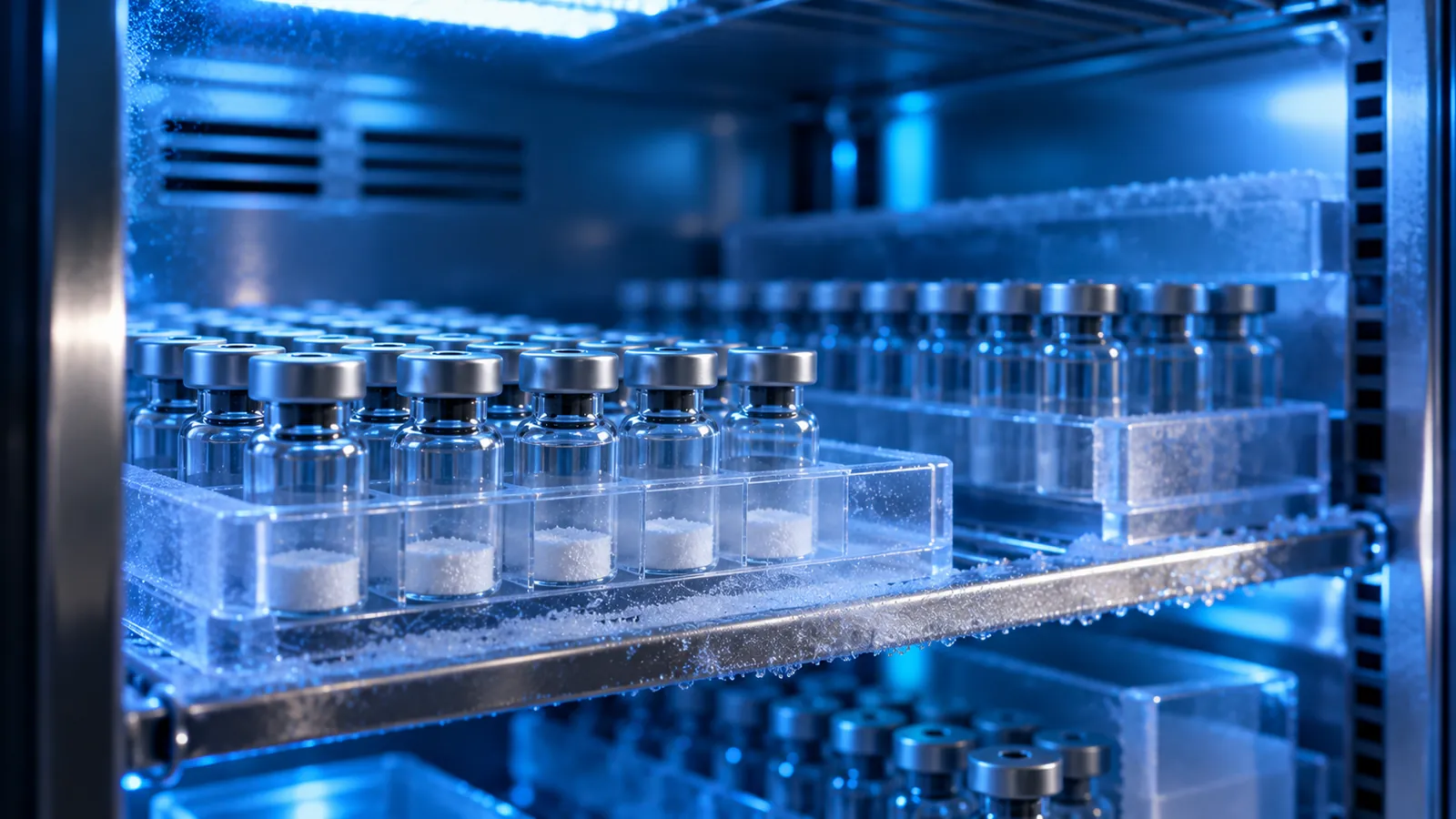
Key takeaways
- Powder (lyophilized) peptides are the most stable form. Keep them cold, dry and dark: refrigerated for routine storage, frozen at −20°C for long-term storage.
- Reconstituted peptides belong in the fridge at 2–8°C, protected from light, and should not be frozen and thawed repeatedly.
- Label every vial with the compound, the date it was reconstituted and the diluent used.
In this guide
- Why storage matters
- Lyophilized peptides
- Reconstituted peptides
- Freeze-thaw damage
- Signs of degradation
- Quick reference
- FAQ
Why storage matters
A peptide is a chain of amino acids, and that chain can break down chemically over time. The main routes are:
- Hydrolysis: water breaks bonds in the peptide chain. This is why moisture is the biggest enemy of a powder.
- Oxidation: residues such as methionine, cysteine and tryptophan react with oxygen, which is sped up by light and heat.
- Deamidation: asparagine and glutamine residues change structure, a reaction that happens faster in solution and at higher temperatures.
- Aggregation: peptide molecules clump together, often triggered by temperature swings and freeze-thaw cycles.
Good storage slows all four. That keeps the compound in the vial close to what its certificate of analysis describes.
Storing lyophilized (powder) peptides
Lyophilization, or freeze-drying, removes almost all the water from a peptide. Without water, most of the reactions above slow dramatically, which is why research peptides are supplied as a dry powder or "cake".
| Timeframe | Where to store | Notes |
|---|---|---|
| In transit & on arrival | Room temperature is fine short term | Lyophilized peptides tolerate normal shipping conditions. Move them to cold storage once they arrive. |
| Routine use | Refrigerator, 2–8°C | Keep vials sealed, upright and in their box or another dark container. |
| Long term | Freezer, −20°C or colder | Store sealed, ideally in a container with a desiccant pack to keep moisture out. |
Let cold vials warm up before opening. If you take a vial from the fridge or freezer, let it reach room temperature before you open or puncture it. Opening a cold vial draws in moist air, and that condensation can settle on the powder.
Storing reconstituted peptides
Once a peptide is dissolved, water is back in the picture and the clock starts ticking faster. Follow these rules for reconstituted vials:
- Refrigerate at 2–8°C. Don't leave reconstituted vials at room temperature for longer than you need to.
- Protect from light. Keep the vial in its box or wrap it in foil.
- Use the right diluent. Bacteriostatic water contains 0.9% benzyl alcohol, which inhibits bacterial growth and allows a vial to be accessed more than once. Sterile water has no preservative and is generally meant for single use. Some compounds are incompatible with benzyl alcohol, so check the right diluent for each one.
- Handle aseptically. Wipe the stopper with an antiseptic before each entry and use sterile equipment every time.
- Label everything. Write the compound, the reconstitution date and the diluent on the vial.
How long a reconstituted peptide stays stable depends on the compound, the diluent and how carefully it's handled. Many labs work within a few weeks of reconstitution and follow compound-specific stability data where it exists.
Avoiding freeze-thaw damage
Every time a peptide solution freezes and thaws, ice crystals form and melt, and the peptide passes through zones of changing concentration. Repeating this encourages aggregation and breakdown.
If a reconstituted peptide needs to be kept for a long time, the standard lab approach is to split it into single-use aliquots (small portions in separate sterile vials), freeze them once, and thaw only what's needed. Never refreeze a thawed aliquot.
Avoid frost-free freezers for long-term storage. They cycle their temperature to prevent ice build-up, which can put samples through small, repeated thaw cycles.
Signs a peptide may have degraded
Most degradation can't be seen, which is why storage conditions matter so much. These signs are worth noting, though:
- Powder that's wet, sticky or collapsed into a gel, rather than a dry cake or pellet. This suggests moisture got in.
- Unexpected colour change. Some compounds are naturally coloured (GHK-Cu is blue because of its copper), so compare against what's expected for that compound.
- Cloudiness, particles or strands in a solution that should be clear.
- Powder that won't dissolve after gentle swirling, when it normally would.
"My vial looks empty." Lyophilized peptide often forms a thin film or a small pellet that can shift around in transit, especially in low-milligram vials. That's normal and doesn't mean the vial is underfilled.
Quick reference
| Item | Storage | Avoid |
|---|---|---|
| Lyophilized peptide (routine) | 2–8°C, dark, sealed | Moisture, heat, direct light |
| Lyophilized peptide (long term) | −20°C or colder, with desiccant | Frost-free freezers, opening while cold |
| Reconstituted peptide | 2–8°C, dark, labelled | Room temperature, repeated freeze-thaw |
| Bacteriostatic water (unopened) | 20–25°C, away from light | Excessive heat |
Frequently asked questions
Do research peptides need to be refrigerated during shipping?
Lyophilized peptides are stable at room temperature for short periods, so normal shipping times are not a concern. Move them to refrigerated or frozen storage once they arrive.
Can I freeze lyophilized peptides?
Yes. Freezing at −20°C or colder is the standard approach for long-term storage of lyophilized peptides. Keep vials sealed, protect them from moisture, and let them reach room temperature before opening.
How long do reconstituted peptides last?
It depends on the compound, the diluent and how the vial is handled. Keep reconstituted peptides refrigerated at 2–8°C, protected from light, and follow compound-specific stability data where it exists. For long-term storage, aliquot and freeze once.
Should I store bacteriostatic water in the fridge?
Unopened bacteriostatic water is stored at controlled room temperature, 20–25°C, away from direct light. Once it's used to reconstitute a peptide, the resulting solution goes in the fridge.
Why does my peptide vial look almost empty?
Lyophilized peptide can form a thin film or small pellet, particularly in low-milligram vials, and it can move around during shipping. This is normal.