Key takeaways
- Growth hormone release is controlled by two stimulating signals, GHRH and ghrelin, and one inhibiting signal, somatostatin.
- CJC-1295 (no DAC) mimics GHRH. Ipamorelin mimics ghrelin at the GHS-R1a receptor.
- Because they act through different receptors, they're studied together to examine how the two signals combine.
In this guide
- The GH axis
- IGF-1 and feedback
- CJC-1295 (no DAC)
- Ipamorelin
- Why study them together
- Research areas
- FAQ
The growth hormone axis
Growth hormone (GH) is made by somatotroph cells in the anterior pituitary gland. Three main signals control how much they release, and when:
| Signal | Source | Effect on GH release |
|---|---|---|
| GHRH (growth hormone-releasing hormone) | Hypothalamus | Stimulates |
| Ghrelin, via the GHS-R1a receptor | Mainly the stomach; also the brain | Stimulates |
| Somatostatin | Hypothalamus | Inhibits |
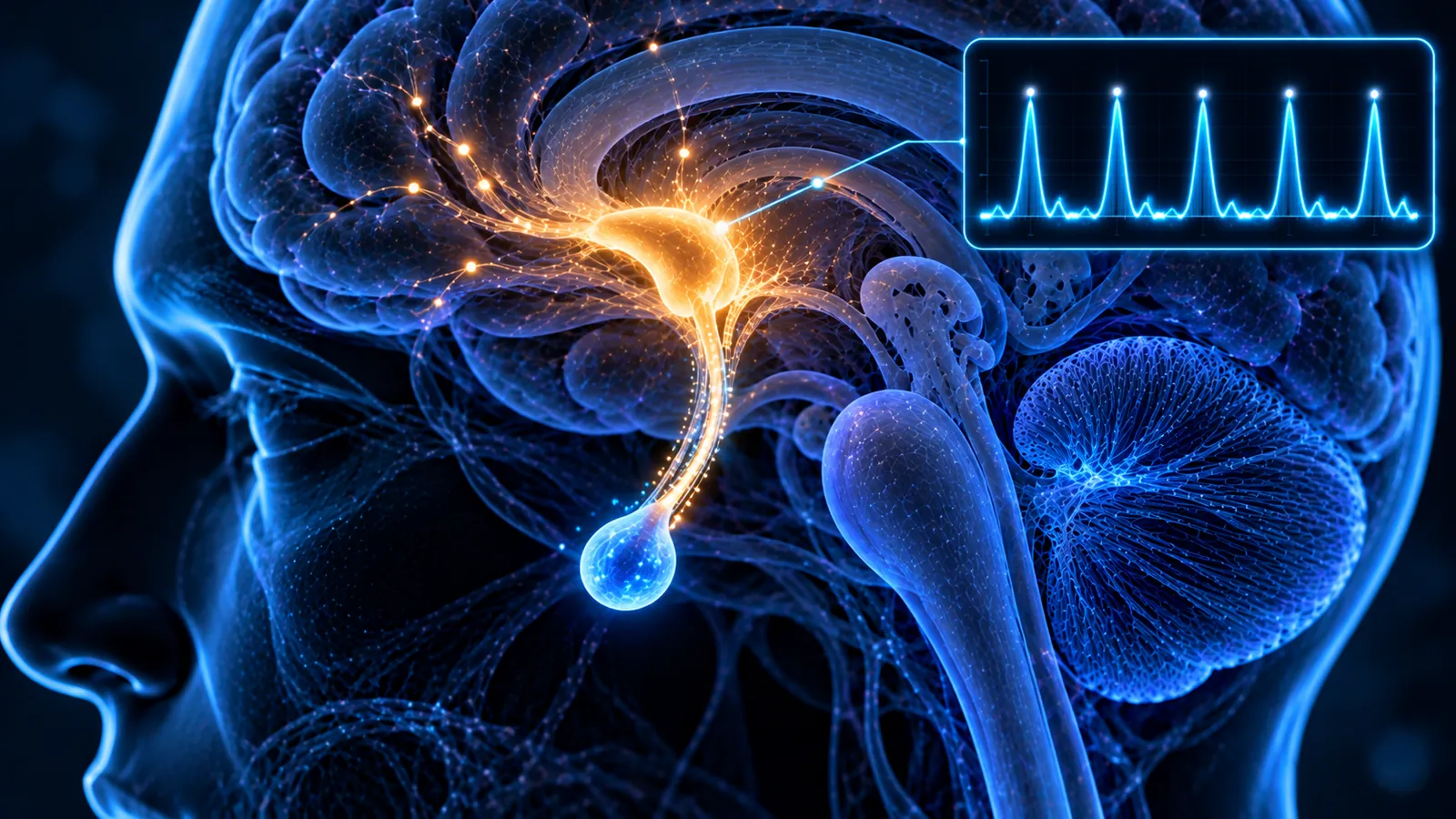
The interplay of GHRH and somatostatin produces GH's characteristic pulsatile pattern: bursts of release separated by quieter periods.
IGF-1 and feedback
Once released, GH acts on the liver and other tissues to produce insulin-like growth factor 1 (IGF-1), which carries out many of GH's downstream effects. IGF-1 and GH then feed back on the hypothalamus and pituitary, raising somatostatin and dampening further GH release. This feedback loop keeps the system in balance.
CJC-1295 (no DAC): mimicking GHRH
CJC-1295 without DAC, also called Mod GRF 1-29, is a 29-amino-acid analogue of GHRH with four substitutions that resist enzymatic breakdown. It binds the GHRH receptor and stimulates GH release, but it's short acting, which preserves the pulsatile pattern. The long-acting version with a drug affinity complex behaves very differently; see CJC-1295 with vs without DAC.
Ipamorelin: mimicking ghrelin
Ipamorelin is a synthetic pentapeptide (Aib-His-D-2-Nal-D-Phe-Lys-NH2, 711.87 g/mol) that activates the growth hormone secretagogue receptor (GHS-R1a), the receptor for ghrelin. It was described as the first selective GH secretagogue: in animal studies it released GH without significantly raising ACTH or cortisol, unlike earlier compounds in its class (Raun et al., European Journal of Endocrinology, 1998).
Why study them together?
GHRH and ghrelin reach the somatotroph through different receptors and different intracellular pathways. Research on the GH axis has long shown that activating both pathways at once produces a stronger GH response than either alone. Pairing a GHRH analogue with a ghrelin-receptor agonist lets researchers study how the two signals combine to shape GH pulses and downstream IGF-1.
That's the rationale behind our CJC-1295 (no DAC) + Ipamorelin blend, with 5mg of each in one vial. Read more about the trade-offs in peptide blends explained.
Key research areas
- GHRH receptor signalling
- Ghrelin receptor (GHS-R1a) activation
- Growth hormone pulsatility
- IGF-1 production and feedback
- Selectivity versus ACTH and cortisol release
These compounds are not approved medicines, and CJC-1295 and ipamorelin are both named among unauthorized peptides in Health Canada's 2026 advisory.
Frequently asked questions
What controls growth hormone release?
Two stimulating signals, GHRH and ghrelin (acting on GHS-R1a), and one inhibiting signal, somatostatin. IGF-1 and GH also feed back to dampen further release.
How do CJC-1295 and ipamorelin differ?
CJC-1295 (no DAC) is a GHRH analogue that acts on the GHRH receptor. Ipamorelin is a ghrelin-receptor agonist that acts on GHS-R1a. They stimulate GH release through different pathways.
Why is ipamorelin called selective?
In animal studies, ipamorelin released growth hormone without significantly raising ACTH or cortisol, unlike earlier growth hormone secretagogues.
Why are CJC-1295 and ipamorelin combined?
Because they act through different receptors, researchers study them together to see how GHRH and ghrelin-receptor signalling combine to shape GH pulses and IGF-1 production.
References
- Raun K, et al. Ipamorelin, the first selective growth hormone secretagogue. Eur J Endocrinol. 1998;139(5):552–561.
- Teichman SL, et al. Prolonged stimulation of growth hormone (GH) and insulin-like growth factor I secretion by CJC-1295, a long-acting analog of GH-releasing hormone, in healthy adults. J Clin Endocrinol Metab. 2006;91(3):799–805.