Key takeaways
- Both are 29-amino-acid GHRH analogues with the same four amino-acid substitutions.
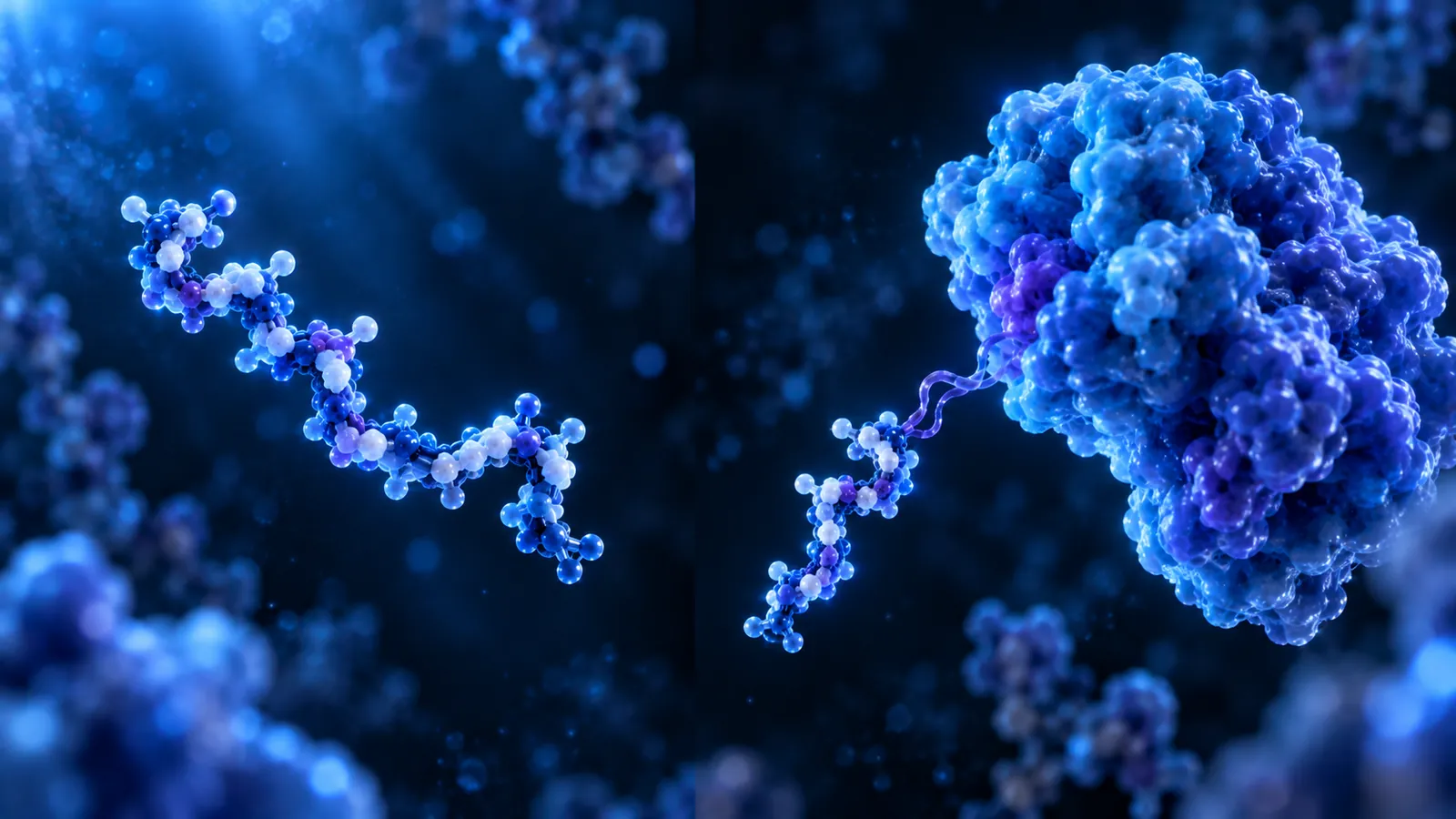
- With DAC, a "drug affinity complex" binds the peptide to albumin in the blood, extending its half-life to several days.
- Without DAC (also called Mod GRF 1-29), it's much shorter acting, more closely resembling the body's natural pulses of GHRH.
In this guide
View CJC-1295 + Ipamorelin →At a glance
| CJC-1295 with DAC | CJC-1295 without DAC | |
|---|---|---|
| Also known as | CJC-1295 DAC | Modified GRF (1-29), Mod GRF 1-29 |
| Base sequence | GHRH(1-29) with four substitutions | GHRH(1-29) with four substitutions |
| Extra group | Drug affinity complex (binds albumin) | None |
| Duration | Long acting: half-life of several days | Short acting: much shorter half-life |
| Signal pattern studied | Sustained elevation of GH and IGF-1 | Short pulses resembling natural GHRH |
Background: what GHRH does
Growth hormone-releasing hormone (GHRH) is made in the hypothalamus. It acts on GHRH receptors in the pituitary gland, prompting the release of growth hormone (GH) in pulses. GH in turn stimulates production of insulin-like growth factor 1 (IGF-1), mostly in the liver.
Native GHRH is broken down within minutes, which makes it impractical for many experiments. Researchers found that the first 29 amino acids, GHRH(1-29), carry its full activity, and that a few targeted changes to that sequence make it far more resistant to breakdown.
CJC-1295 without DAC (Mod GRF 1-29)
CJC-1295 without DAC is GHRH(1-29) with four amino-acid substitutions that protect it from enzymatic breakdown. This makes it longer lasting than native GHRH, but it's still short acting, measured in minutes rather than days.
That short duration is the point for many researchers. Because it produces a brief signal and then clears, it's used to study pulsatile GH release that resembles the body's natural pattern. It's often paired with ipamorelin, a ghrelin-receptor agonist that stimulates GH release through a second pathway, as in our CJC-1295 (no DAC) + Ipamorelin blend.
CJC-1295 with DAC
CJC-1295 with DAC takes the same modified sequence and adds a drug affinity complex (DAC): a reactive chemical group attached to the peptide that lets it bond to albumin, the most abundant protein in blood. Bound to albumin, the peptide is shielded from breakdown and clearance.
The result is a dramatically longer half-life. In a clinical pharmacology study in healthy adults, CJC-1295 with DAC produced sustained, dose-dependent increases in GH and IGF-1 lasting days after a single administration (Teichman et al., Journal of Clinical Endocrinology & Metabolism, 2006).
Findings don't transfer between the two. Because the DAC changes how long the compound acts and the pattern of signalling it produces, research on CJC-1295 with DAC can't be assumed to apply to the no-DAC form, or the reverse.
Why the distinction matters
- Different signalling patterns. A sustained signal and a pulsatile signal can produce different downstream effects, so they answer different research questions.
- Labelling confusion. Some suppliers sell "CJC-1295" without saying which form it is. Always confirm, and check the certificate of analysis.
- Different molecular weights. The DAC adds mass, so identity testing by mass spectrometry will clearly distinguish the two. See how peptide purity is tested.
Related: tesamorelin
Tesamorelin is another GHRH analogue, but a different design. It keeps all 44 amino acids of native GHRH and adds a trans-3-hexenoyl group to the start of the chain for stability. It's one of the best-studied GHRH analogues in the clinical literature.
Frequently asked questions
What is the difference between CJC-1295 with DAC and without DAC?
Both are modified 29-amino-acid GHRH analogues. The DAC version carries a drug affinity complex that binds albumin and extends its half-life to several days. The no-DAC version (Mod GRF 1-29) is much shorter acting and more closely resembles natural pulsatile GHRH.
What does DAC stand for?
DAC stands for drug affinity complex, a chemical group that allows the peptide to bond to albumin in the blood, protecting it from breakdown and extending its duration of action.
Is Mod GRF 1-29 the same as CJC-1295 without DAC?
Yes. Modified GRF (1-29), or Mod GRF 1-29, is another name for CJC-1295 without DAC.
Which form is in BioAscend's CJC-1295 + Ipamorelin blend?
Our blend contains CJC-1295 without DAC (Mod GRF 1-29), 5mg, with 5mg of ipamorelin in one 10mg vial.
References
- Teichman SL, et al. Prolonged stimulation of growth hormone (GH) and insulin-like growth factor I secretion by CJC-1295, a long-acting analog of GH-releasing hormone, in healthy adults. J Clin Endocrinol Metab. 2006;91(3):799–805.
- Raun K, et al. Ipamorelin, the first selective growth hormone secretagogue. Eur J Endocrinol. 1998;139(5):552–561.