
Key takeaways
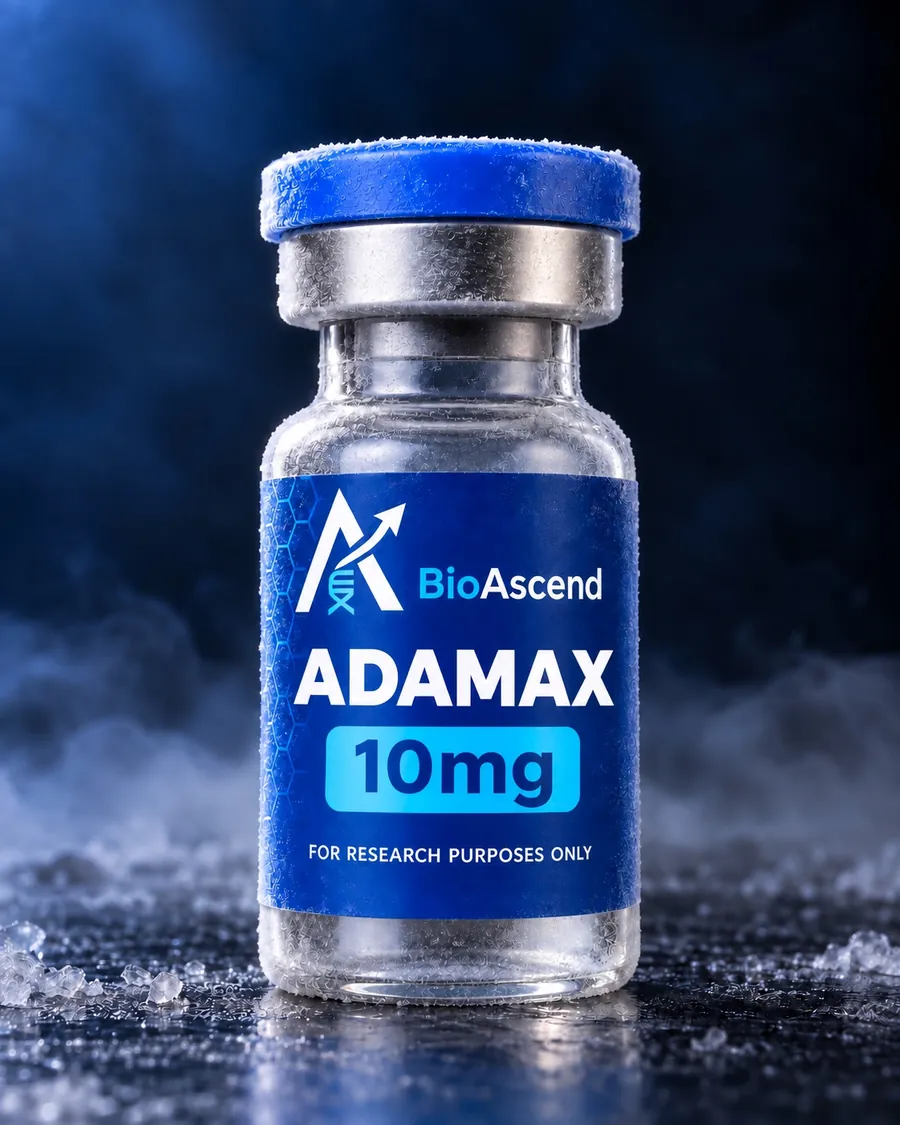
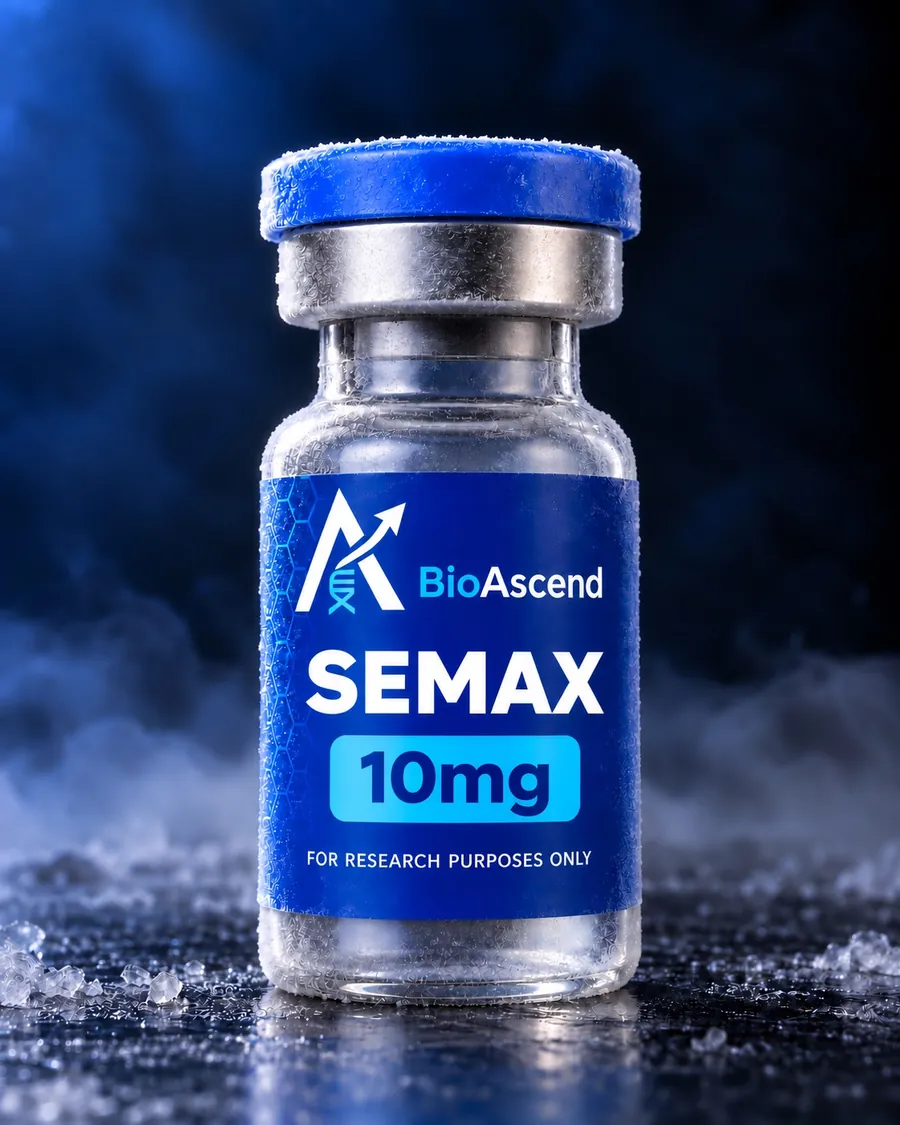
- Adamax is an investigational analogue of Semax, the ACTH(4-10)-derived heptapeptide.
- Third-party testing of BioAscend's Adamax measured a mass of about 1032 Da, compared with about 814 Da for Semax.
- There's very little peer-reviewed literature on Adamax itself. Most research context comes from studies of Semax.
In this guide
View Adamax 10mg →Background: Semax
To understand Adamax, it helps to start with Semax. Semax is a seven-amino-acid peptide (Met-Glu-His-Phe-Pro-Gly-Pro) built from a fragment of adrenocorticotropic hormone, ACTH(4-10), with a Pro-Gly-Pro tail added to make it more resistant to breakdown. It was developed in Russia and has a substantial research literature.
One of the most cited findings is that Semax increased expression of brain-derived neurotrophic factor (BDNF) and its receptor TrkB in the rat hippocampus (Dolotov et al., Brain Research, 2006). BDNF supports neuron survival and synaptic plasticity, which is why Semax is studied in cognition and neuroprotection research.
What is Adamax?
Adamax is described as a Semax analogue with structural modifications intended to change its stability and activity. Its exact structure isn't well documented in the peer-reviewed literature, so we report what can be measured directly.
| Semax | Adamax | |
|---|---|---|
| Origin | ACTH(4-10) analogue with Pro-Gly-Pro | Modified Semax analogue |
| Molecular mass | About 814 Da | About 1032 Da (measured) |
| Peer-reviewed literature | Substantial | Very limited |
| Main research interest | BDNF/TrkB, cognition, neuroprotection | Whether modifications change Semax-like activity |
The roughly 218 Da increase in mass is consistent with an added chemical group, but mass alone doesn't tell you where on the molecule it sits or what it does.
Research questions
With so little published data, Adamax research is largely exploratory. The questions researchers typically ask include:
- Is it more stable against enzymatic breakdown than Semax?
- Does it affect BDNF and TrkB signalling the way Semax does?
- How do its pharmacokinetics compare with Semax's very short half-life?
- Does the modification change its receptor interactions?
Studying Adamax directly alongside Semax in the same model is the clearest way to answer these questions.
A note on evidence
It's easy to find claims online about Adamax being "stronger" or "longer-lasting" than Semax. Those claims aren't supported by published research yet. Findings for Semax shouldn't be assumed to carry over to Adamax, since even small structural changes can alter how a peptide behaves.
Adamax is an investigational research compound only. It is not an approved medicine in any country, and there is no clinical research on its safety or effects in people.
Why testing matters more here
For a peptide with little reference literature, independent analytical testing is especially important. Mass spectrometry confirms the molecular mass, and HPLC measures purity. See how peptide purity is tested and how to read a COA.
Frequently asked questions
What is Adamax?
Adamax is an investigational research peptide developed as a modified analogue of Semax, the ACTH(4-10)-derived heptapeptide studied in cognition and neuroprotection research.
How is Adamax different from Semax?
Adamax carries structural modifications that give it a larger molecular mass (about 1032 Da vs about 814 Da for Semax). Whether those changes alter its activity hasn't been established in published research.
Is there published research on Adamax?
Very little. Most of the research context comes from the established literature on Semax rather than from studies of Adamax itself.
Is Adamax stronger than Semax?
There's no published evidence to support that claim. Comparing the two would require direct studies in the same experimental model.
References
- Dolotov OV, et al. Semax, an analog of ACTH(4-10) with cognitive effects, regulates BDNF and trkB expression in the rat hippocampus. Brain Res. 2006;1117(1):54–60.