
Key takeaways
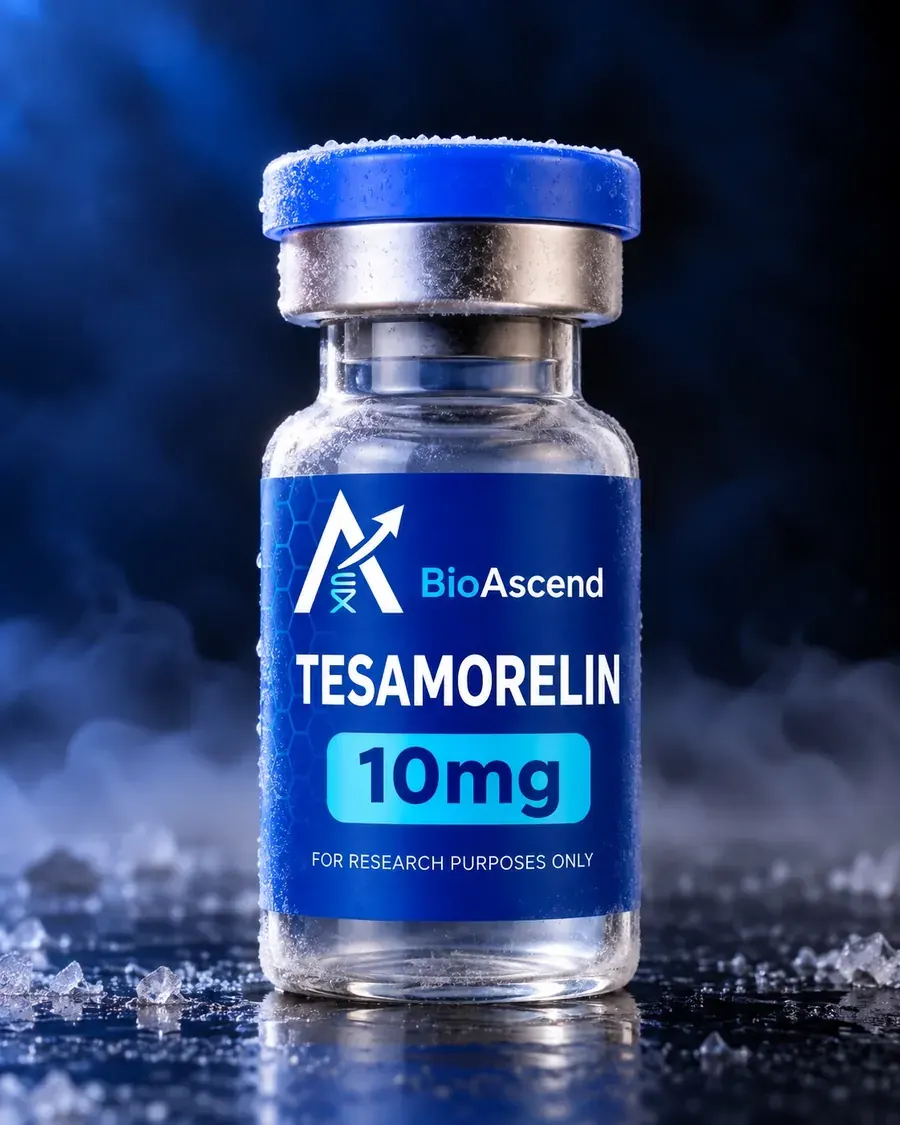
- Tesamorelin is the full 44-amino-acid GHRH sequence with a trans-3-hexenoyl group added for stability.
- It works upstream, at the GHRH receptor in the pituitary, preserving the body's own feedback on growth hormone release.
- It was approved in 2010 as Egrifta for a specific indication, and clinical studies have focused on visceral fat and liver fat.
In this guide
View Tesamorelin 10mg →Compound overview
| Property | Detail |
|---|---|
| Type | Growth hormone-releasing hormone (GHRH) analogue |
| Length | 44 amino acids, with an N-terminal trans-3-hexenoyl group |
| Developer | Theratechnologies (Montreal) |
| CAS number | 218949-48-5 |
| Molecular formula | C221H366N72O67S |
| Molecular weight | 5,135.86 g/mol |
How tesamorelin is built
Native GHRH, made in the hypothalamus, is broken down within minutes. Tesamorelin keeps all 44 amino acids of the human hormone and adds a trans-3-hexenoyl group to the start of the chain. That small modification makes it far more resistant to enzymatic breakdown while keeping its activity at the GHRH receptor.
This differs from CJC-1295, which is based on only the first 29 amino acids of GHRH, with four substitutions.
Mechanism of action
Tesamorelin binds GHRH receptors on somatotroph cells in the anterior pituitary, prompting them to release growth hormone (GH) in pulses. GH in turn stimulates production of insulin-like growth factor 1 (IGF-1), mostly in the liver.
Because it acts upstream, at the pituitary, rather than supplying growth hormone directly, the body's regulatory feedback stays in place: IGF-1 and somatostatin can still restrain further GH release. That makes tesamorelin useful for studying the relationship between the body's own GH secretion, IGF-1 signalling and fat metabolism.
Clinical studies
Visceral adipose tissue
Tesamorelin is best known for research on visceral adipose tissue, the deep abdominal fat around internal organs. A randomized, placebo-controlled trial in patients with HIV-associated abdominal fat accumulation reported reductions in visceral fat, along with changes in lipid and IGF-1 levels (Falutz et al., New England Journal of Medicine, 2007). A pooled analysis of two phase 3 trials, including safety extension data, examined these effects in a larger population (Falutz et al., Journal of Clinical Endocrinology & Metabolism, 2010).
Approval
Based on this research, tesamorelin was approved in 2010 under the name Egrifta for that specific clinical indication. It remains one of the few GHRH analogues with an approved use.
Liver fat
Later clinical research examined tesamorelin in relation to liver fat and body composition, extending interest into fatty liver research.
Key research areas
- GHRH receptor signalling
- Growth hormone pulsatility and IGF-1 regulation
- Visceral adipose tissue metabolism
- Lipid metabolism and body composition
- Liver fat research
For a broader view of the system tesamorelin acts on, see CJC-1295 and Ipamorelin: understanding GH signalling.
Frequently asked questions
What is tesamorelin?
Tesamorelin is a synthetic analogue of growth hormone-releasing hormone (GHRH). It keeps all 44 amino acids of human GHRH, with a trans-3-hexenoyl group added to make it more stable.
How does tesamorelin work?
It binds GHRH receptors in the pituitary, prompting pulsatile release of growth hormone, which in turn raises IGF-1. Because it acts upstream, the body's normal feedback on GH release stays intact.
Is tesamorelin approved?
Yes, for a specific indication. It was approved in 2010 as Egrifta. Research-grade tesamorelin supplied by BioAscend is for laboratory use only.
How is tesamorelin different from CJC-1295?
Tesamorelin keeps the full 44-amino-acid GHRH sequence with an N-terminal modification. CJC-1295 is based on the first 29 amino acids of GHRH with four substitutions.
References
- Falutz J, et al. Metabolic effects of a growth hormone-releasing factor in patients with HIV. N Engl J Med. 2007;357(23):2359–2370.
- Falutz J, et al. Effects of tesamorelin (TH9507), a growth hormone-releasing factor analog, in human immunodeficiency virus-infected patients with excess abdominal fat: a pooled analysis of two multicenter, double-blind placebo-controlled phase 3 trials with safety extension data. J Clin Endocrinol Metab. 2010;95(9):4291–4304.