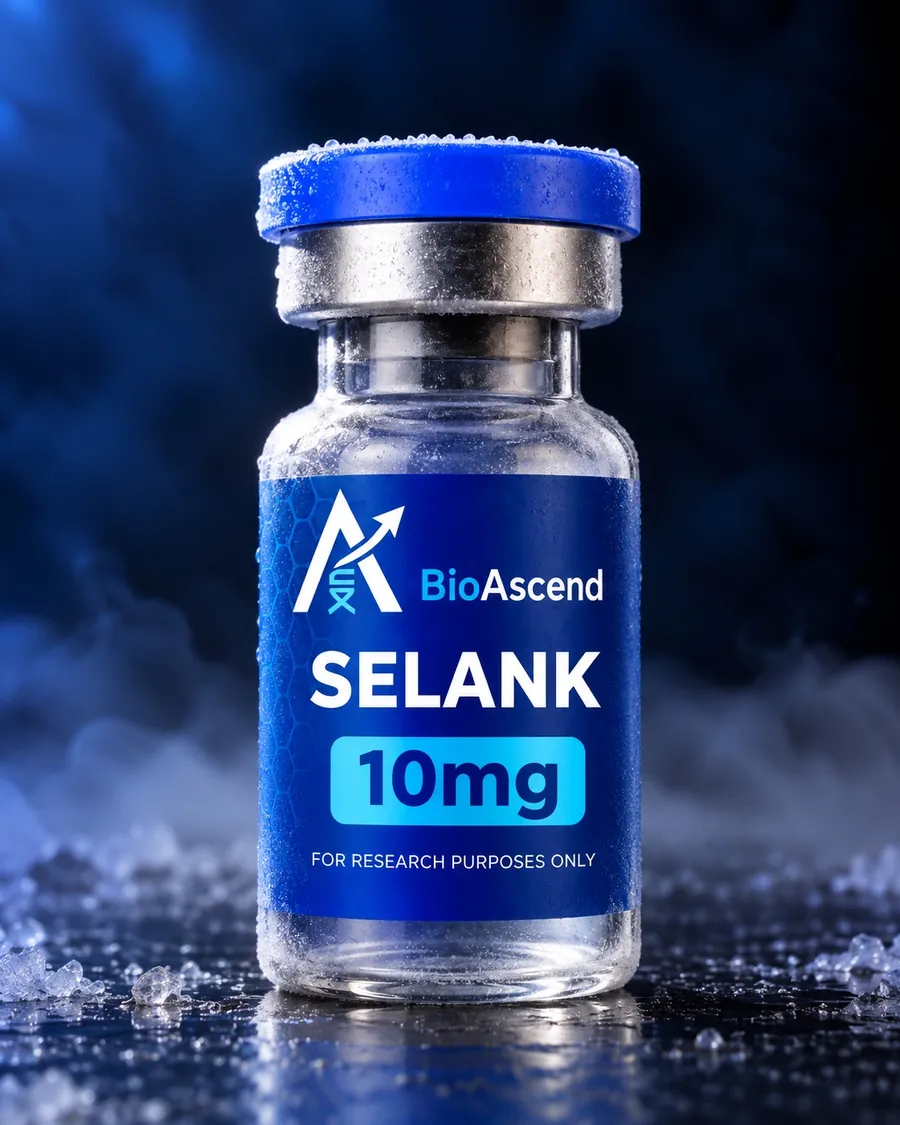

Key takeaways
- Selank is a synthetic heptapeptide (Thr-Lys-Pro-Arg-Pro-Gly-Pro) based on the immune peptide tuftsin.
- Research covers stress responses, monoamines (serotonin, dopamine), GABAergic gene expression and BDNF.
- Its immune origin also makes it a subject of cytokine and immune-cell research.
In this guide
- What is Selank?
- Built from an immune peptide
- Neurobiological research
- Immune research
- Research areas
- Related research
- FAQ
What is Selank?
Selank has the sequence TKPRPGP and a molecular weight of 751.89 g/mol (CAS 129954-34-3). Like Semax, it was developed at the Institute of Molecular Genetics of the Russian Academy of Sciences. It is not approved in Canada or the United States.
Built from an immune peptide
Tuftsin is a four-amino-acid peptide (Thr-Lys-Pro-Arg) that occurs naturally as a fragment of immunoglobulin G, the most common antibody in the blood. It stimulates immune cells such as macrophages.
Selank adds a Pro-Gly-Pro tail to the tuftsin sequence. As with Semax, this makes the peptide much more resistant to enzymatic breakdown.
Neurobiological research
Monoamines
Animal studies have reported changes in brain levels of monoamine neurotransmitters, such as serotonin and dopamine, after Selank administration.
GABAergic signalling
A gene-expression study reported that Selank affected the expression of genes involved in GABAergic neurotransmission, the brain's main inhibitory system (Volkova et al., Frontiers in Pharmacology, 2016).
BDNF
In rats, intranasal Selank was reported to regulate BDNF expression in the hippocampus (Inozemtseva et al., Doklady Biological Sciences, 2008).
Enkephalins
Like Semax, Selank inhibits enzymes that break down enkephalins in human serum (Kost et al., 2001), which may contribute to its effects in stress models.
Immune research
Because of its tuftsin origin, Selank is also studied for effects on cytokine expression and immune-cell responses, making it a tool for research at the interface of the nervous and immune systems.
Key research areas
- Stress-response and anxiety-related behaviour models
- Serotonin, dopamine and GABAergic signalling
- BDNF expression in the hippocampus
- Enkephalin-degrading enzyme inhibition
- Immunomodulation and cytokine research
Selank is not approved in Canada or the United States. The findings above come largely from animal research.
Related research
See Semax vs Selank for how the two compare, and Semax and cognitive research for a full profile of its sister peptide.
Frequently asked questions
What is Selank?
Selank is a synthetic seven-amino-acid peptide (Thr-Lys-Pro-Arg-Pro-Gly-Pro) based on tuftsin, an immune peptide. It's studied mainly in stress-response, anxiety-related behaviour and immune research.
What is tuftsin?
Tuftsin is a four-amino-acid peptide (Thr-Lys-Pro-Arg) that occurs naturally as a fragment of immunoglobulin G and stimulates immune cells.
How is Selank different from Semax?
Selank is derived from the immune peptide tuftsin and is studied mainly in stress and anxiety research. Semax is derived from the hormone ACTH and is studied mainly for neurotrophic and cognitive effects.
Is Selank approved in Canada?
No. Selank is not approved in Canada or the United States.
References
- Volkova A, et al. Selank administration affects the expression of some genes involved in GABAergic neurotransmission. Front Pharmacol. 2016;7:31.
- Inozemtseva LS, et al. Intranasal administration of the peptide Selank regulates BDNF expression in the rat hippocampus in vivo. Dokl Biol Sci. 2008;421:241–243.
- Kost NV, et al. Semax and Selank inhibit the enkephalin-degrading enzymes from human serum. Russ J Bioorg Chem. 2001;27(3):180–183.