Key takeaways
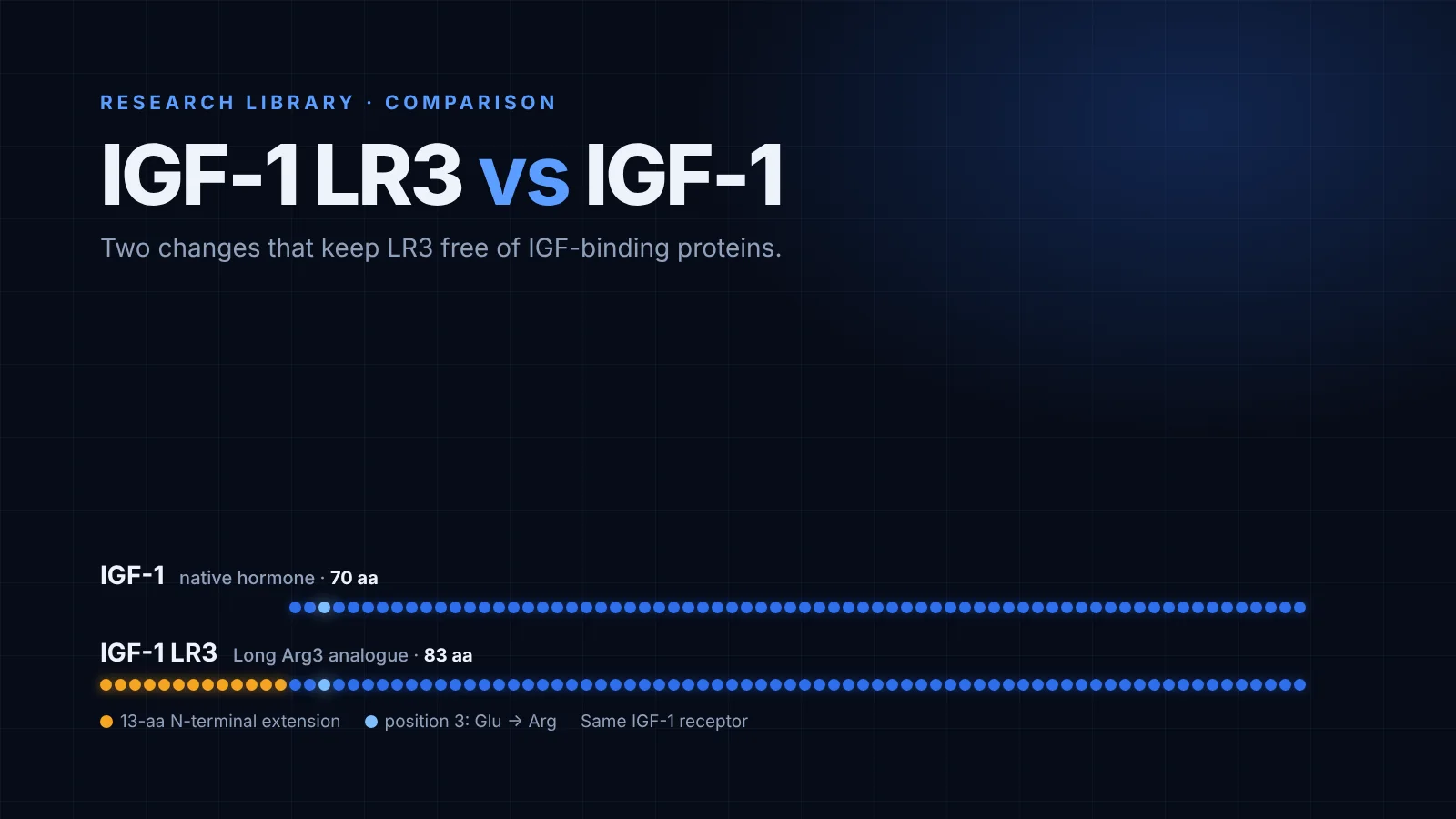
- Native IGF-1 has 70 amino acids. IGF-1 LR3 has 83: an arginine swap at position 3 plus a 13-amino-acid N-terminal extension.
- These changes greatly reduce binding to IGF-binding proteins (IGFBPs), so more of the peptide stays free to activate the receptor.
- It activates the same IGF-1 receptor and downstream PI3K–Akt and MAPK pathways, and it's widely used in cell culture.
In this guide
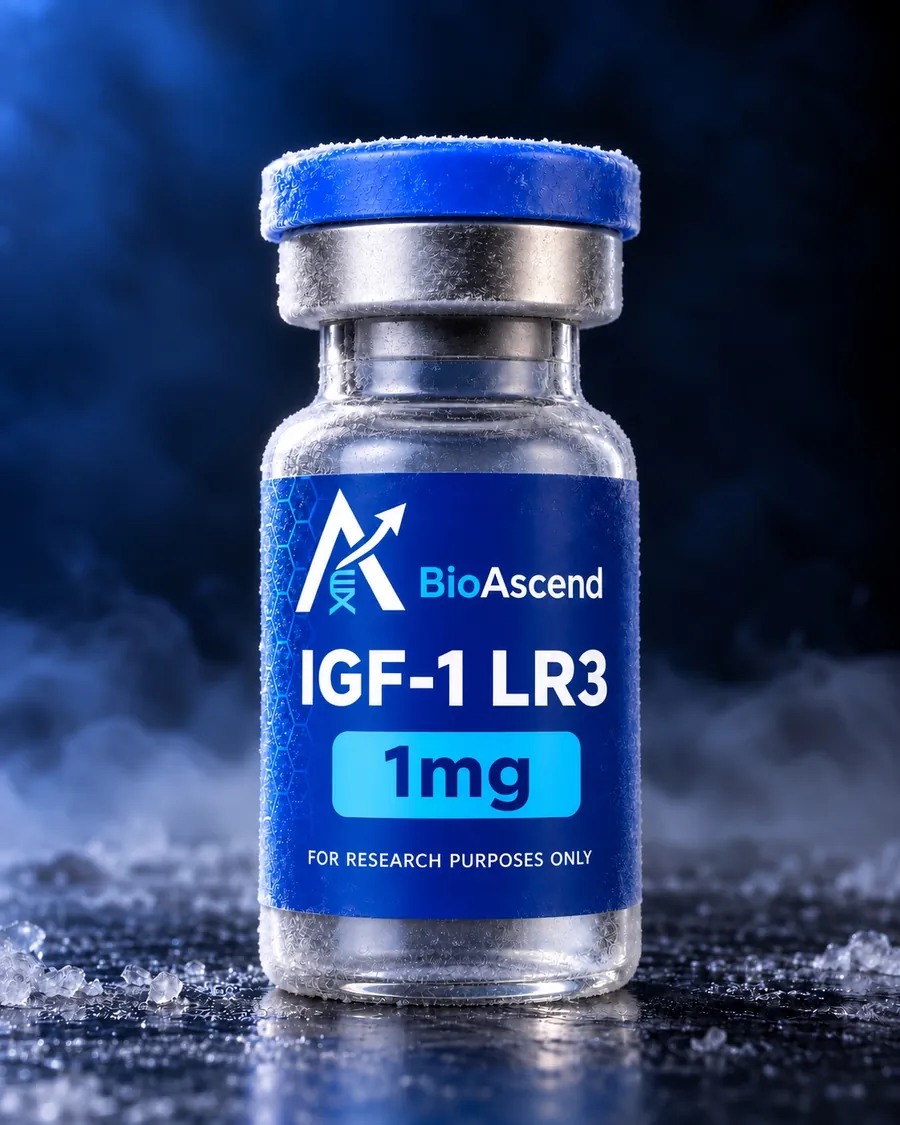
View IGF-1 LR3 1mg →At a glance
| Native IGF-1 | IGF-1 LR3 | |
|---|---|---|
| Length | 70 amino acids | 83 amino acids |
| Position 3 | Glutamic acid (Glu3) | Arginine (Arg3) |
| N-terminus | Standard | 13-amino-acid extension |
| Molecular weight | About 7.6 kDa | About 9.1 kDa |
| IGFBP binding | Strong; most is bound | Greatly reduced |
| Receptor | IGF-1 receptor | IGF-1 receptor |
How native IGF-1 works
Insulin-like growth factor 1 is a 70-amino-acid hormone made mainly in the liver in response to growth hormone. It's a key part of the GH–IGF-1 axis and acts on almost every tissue through the IGF-1 receptor, a receptor tyrosine kinase related to the insulin receptor.
In circulation, very little IGF-1 is free. Most is bound to one of six IGF-binding proteins, especially IGFBP-3, which forms a large complex that holds IGF-1 in reserve and extends its life in the blood. Locally, binding proteins also control how much IGF-1 can reach cells.
What makes LR3 different
The R3 substitution
Swapping glutamic acid for arginine at position 3 disrupts one of the regions IGFBPs use to grip IGF-1. On its own, this change (known as R3-IGF-1) already reduces binding-protein affinity.
The long extension
Adding a 13-amino-acid extension to the N-terminus further reduces IGFBP binding. Together, the two changes produced an analogue with markedly lower binding-protein affinity and greater biological potency in many experimental systems, while keeping its ability to activate the IGF-1 receptor (Francis et al., Journal of Molecular Endocrinology, 1992).
The extra potency in experiments comes mainly from more of the peptide staying free and available, not from stronger binding to the receptor itself.
Receptor signalling
Once it binds the IGF-1 receptor, IGF-1 LR3 triggers the same intracellular pathways as native IGF-1:
- PI3K–Akt–mTOR: linked to protein synthesis, cell growth and survival
- MAPK/ERK: linked to cell proliferation and differentiation
Because these pathways are central to growth and metabolism, IGF-1 LR3 is used as a tool to study what happens when IGF-1 receptor signalling is strongly and consistently activated.
Where it's used in research
IGF-1 LR3's most established use is in cell culture. Because it isn't neutralised by the binding proteins cells secrete, it's a reliable growth supplement in serum-free media, including in biomanufacturing cell lines. Other research areas include:
- Muscle cell (myoblast) proliferation and differentiation
- Protein synthesis and mTOR signalling
- IGF binding protein biology
- Growth hormone axis research, alongside GHRH analogues like tesamorelin
IGF-1 LR3 is a research compound only. It is not an approved medicine, and its potency in experimental systems is a reason for careful handling and precise measurement.
Frequently asked questions
What does LR3 stand for?
"Long" refers to the 13-amino-acid extension at the N-terminus, and "R3" refers to arginine replacing glutamic acid at position 3.
Why is IGF-1 LR3 more potent than IGF-1 in experiments?
Its two modifications greatly reduce binding to IGF-binding proteins, which normally hold most IGF-1 in an inactive reserve. More of the peptide stays free to activate the IGF-1 receptor.
Does IGF-1 LR3 bind the same receptor as IGF-1?
Yes. It activates the IGF-1 receptor and the same downstream PI3K–Akt and MAPK/ERK pathways.
Why is IGF-1 LR3 used in cell culture?
Cells secrete IGF-binding proteins that can neutralise native IGF-1 in culture. Because LR3 largely escapes them, it's a more consistent growth supplement in serum-free media.
References
- Francis GL, et al. Novel recombinant fusion protein analogues of insulin-like growth factor (IGF)-I indicate the relative importance of IGF-binding protein and receptor binding for enhanced biological potency. J Mol Endocrinol. 1992;8(3):213–223.
- Jones JI, Clemmons DR. Insulin-like growth factors and their binding proteins: biological actions. Endocr Rev. 1995;16(1):3–34.