Key takeaways
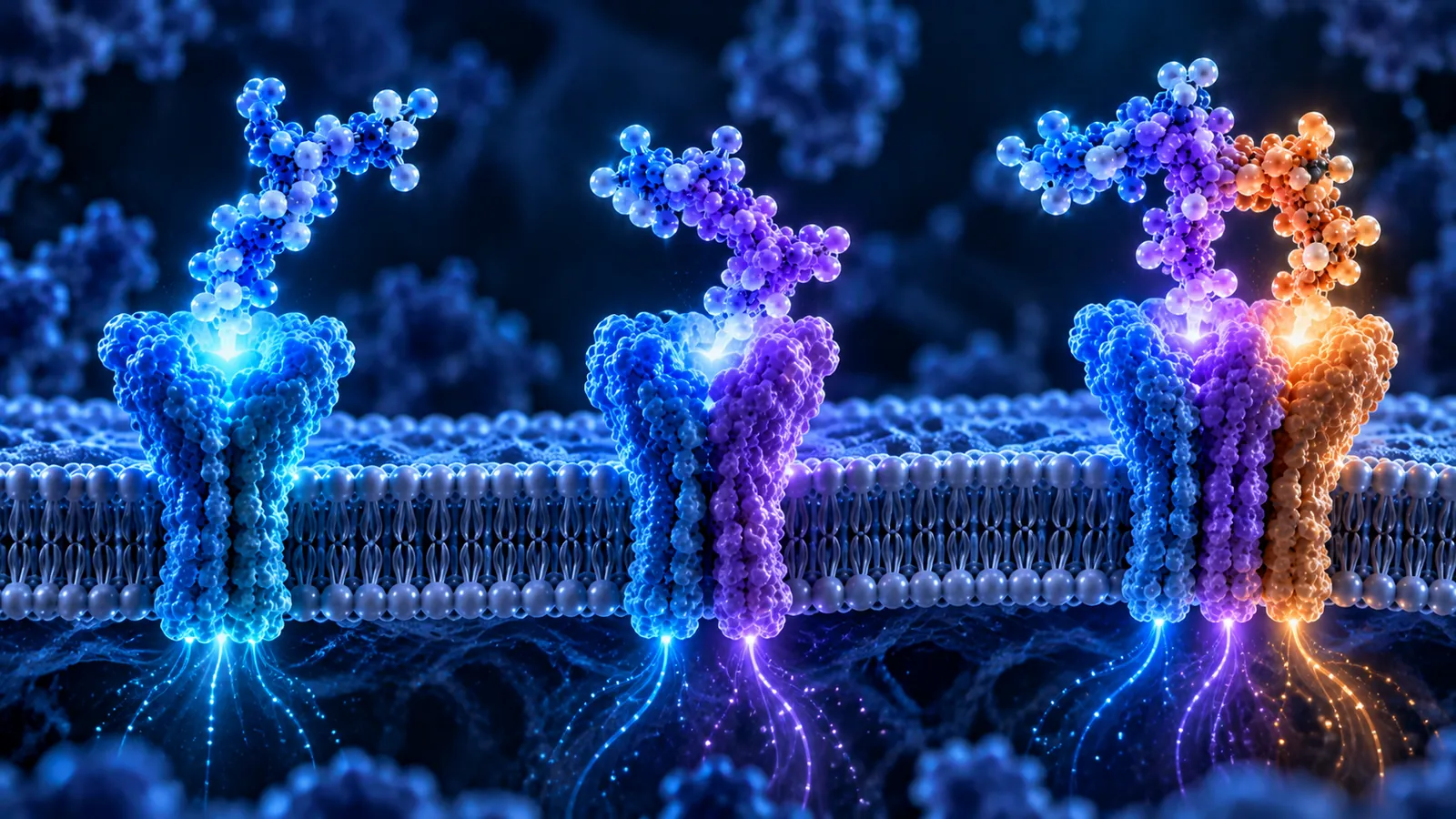
- Semaglutide activates one receptor (GLP-1). Tirzepatide activates two (GIP and GLP-1). Retatrutide activates three (GIP, GLP-1 and glucagon).
- Semaglutide and tirzepatide are approved prescription medicines. Retatrutide is investigational and not approved by Health Canada or the FDA.
- The glucagon receptor is what sets retatrutide apart, adding a pathway linked to energy expenditure and liver fat metabolism.
In this guide
View Retatrutide →At a glance
| Semaglutide | Tirzepatide | Retatrutide | |
|---|---|---|---|
| Receptor targets | GLP-1 | GIP + GLP-1 | GIP + GLP-1 + glucagon |
| Type | Single agonist | Dual agonist | Triple agonist |
| Developer | Novo Nordisk | Eli Lilly | Eli Lilly |
| Development code | NN9535 | LY3298176 | LY3437943 |
| Status | Approved prescription medicine | Approved prescription medicine | Investigational (phase 3) |
The three receptors
All three compounds mimic hormones the body already makes. Understanding those hormones explains the differences.
GLP-1 (glucagon-like peptide-1)
An incretin hormone released by the gut after eating. Its receptor is found in the pancreas, brain and other tissues, and is involved in insulin secretion, appetite signalling and slowing gastric emptying.
GIP (glucose-dependent insulinotropic polypeptide)
The other main incretin hormone. GIP also stimulates insulin secretion after a meal, and its receptor is found in pancreatic and fat tissue. Combining GIP and GLP-1 activity was the idea behind tirzepatide.
Glucagon
A hormone from the pancreas that generally works opposite to insulin, raising glucose output from the liver. Its receptor is also associated with lipid metabolism and energy expenditure. Adding glucagon receptor activity is retatrutide's distinguishing feature.
Semaglutide: the single agonist
Semaglutide is a GLP-1 receptor agonist modified with a fatty-acid side chain that binds albumin in the blood, extending its half-life enough for once-weekly administration in clinical use. It's an approved prescription medicine in Canada and many other countries, sold under brand names including Ozempic and Wegovy.
Tirzepatide: the dual agonist
Tirzepatide is a single peptide engineered to activate both the GIP and GLP-1 receptors. Its development tested the idea that combining two incretin pathways would produce stronger metabolic effects than GLP-1 alone. It's an approved prescription medicine, sold under brand names including Mounjaro and Zepbound.
Retatrutide: the triple agonist
Retatrutide (LY3437943) adds glucagon receptor activity to the GIP and GLP-1 combination. In its discovery study, it showed comparatively stronger activity at the GIP receptor with more balanced activity at the GLP-1 and glucagon receptors (Coskun et al., Cell Metabolism, 2022).
Phase 2 trials were published in 2023 (Jastreboff et al., New England Journal of Medicine; Rosenstock et al., The Lancet), and Eli Lilly announced topline results from its phase 3 TRIUMPH program in 2026. Retatrutide remains investigational: it is not approved by Health Canada, the FDA or any other regulator.
Why add glucagon? On its own, glucagon raises blood glucose, which seems counterintuitive in a metabolic compound. The research interest is in pairing it with incretin activity, which can offset that effect, while studying glucagon's links to energy expenditure and liver fat metabolism.
What researchers study with these compounds
- Receptor pharmacology: how strongly each compound activates each receptor, and how balanced its activity is.
- Single vs multi-receptor signalling: whether combined pathways interact, add together or offset each other.
- Glucose regulation and insulin secretion in cell and animal models.
- Appetite signalling, energy expenditure and lipid metabolism, including liver fat.
Frequently asked questions
What is the difference between retatrutide, tirzepatide and semaglutide?
They act on different numbers of receptors. Semaglutide activates the GLP-1 receptor, tirzepatide activates the GIP and GLP-1 receptors, and retatrutide activates the GIP, GLP-1 and glucagon receptors.
Is retatrutide approved?
No. Retatrutide is an investigational compound in phase 3 clinical trials. It has not been approved by Health Canada, the FDA or any other drug regulator.
Why is retatrutide called a triple agonist?
Because a single retatrutide molecule activates three hormone receptors: GIP, GLP-1 and glucagon.
Who developed retatrutide?
Retatrutide was developed by Eli Lilly and Company, which also developed tirzepatide. Semaglutide was developed by Novo Nordisk.
References
- Coskun T, et al. LY3437943, a novel triple glucagon, GIP, and GLP-1 receptor agonist for glycemic control and weight loss. Cell Metab. 2022;34(9):1234–1247.
- Jastreboff AM, et al. Triple-hormone-receptor agonist retatrutide for obesity — a phase 2 trial. N Engl J Med. 2023;389(6):514–526.
- Rosenstock J, et al. Retatrutide, a GIP, GLP-1 and glucagon receptor agonist, for people with type 2 diabetes: a phase 2 trial. Lancet. 2023.